
Which chemistry textbooks are best to survive your degree, or to simply learn more about chemistry due to personal interest?
The good and bad news is that there a LOT of textbooks. The list below captures ones that I can recommend, primarily focused on organic chemistry.
For pragmatic students: Always check the list of your uni course / program! If your professor has a ‘favorite’ (sometimes they wrote them themselves, lol), treat it like holy scripture. They might simply copy-paste problems, allowing you to get some easy points. However, I always recommend looking at more than one book because the quality and clarity of explanations can differ a lot – and we all learn differently.
Beginner Organic Chemistry
Organic Chemistry I For Dummies by Winter
Start here if you are absolutely friggin clueless. My videos don’t explain fundamental concepts, but there are plenty of other channels or playlists. At this point, you will likely learn much better with videos than reading.
Organic Chemistry by Clayden, Greeves & Warren
This the orgo book to get an overview of reaction mechanisms, reactivities, named reactions, analytical methods, introduction to synthesis… This one will serve you for basically all your undergraduate organic chemistry courses.
Molecules That Changed the World by Nicolaou & Montagnon
Introduction to natural products and some nice historical / contemporary context. This is awesome if you’d like to literally learn more about the world.
Intermediate to Advanced Organic Chemistry
Advanced Organic Chemistry by Carey & Sundberg
Perfect place to build on the above to go from basic to advanced. Part A focuses on structure and mechanisms, Part B focuses on reactions and synthesis.
The Art of Writing Reasonable Organic Reaction Mechanisms by Grossman
Great to build intuition for intermediate and advanced reaction mechanisms. Now we are definitely leaving the ‘memorization’ sphere.
Organic Synthesis: The Disconnection Approach by Warren & Wyatt
Excellent book on (retro)synthesis. Explains how important classes of chemicals, pharmaceuticals, dyes… are made by industry.
Modern Physical Organic Chemistry by Anslyn
Unfortunately a lot of organic chemistry depends on physical chemistry. This book has you covered on most of your needs, though phys org chem can depend more on lecture materials than books (because it can be very subjective how professors cover these topics).
Strategic Applications of Named Reactions in Organic Synthesis by Kurti & Czako
Encyclopedia of functional group reactions, mechanisms and common conditions. This includes a bunch of random ass reactions you see once in a blue moon, so this is a reference rather than a book to read cover to cover (it’s way less ‘strategic’ than the name implies).
Graduate-level Organic Chemistry
Classics in Total Synthesis by Nicolaou. Book 1, 2, 3 and 4
This is a simply legendary series. Anyone interested in total synthesis needs to read at least the first book. If you read this in your second or third year of undergraduate, you can definitely get ahead of the curve. To learn modern about modern syntheses, you should just look at recent reviews or individual publications in JACS, Angewandte Chemie, Organic Letters, Nature Chemistry…
Classics in Stereoselective Synthesis by Carreira and Kvaerno
Summarizes key stereoselectivity models and explains intermediate to extremely advanced applications in total synthesis. It’s not a well-known book but if you’re a graduate in total synthesis, you should read it.
The Logic of Chemical Synthesis by Corey & Cheng
Some people recommend this but I disagree – this book will probably confuse you. I only recommend this if you read everything else, or if your professor has a shrine of Corey and asks you for insane details (how do you identify segments of nCL stereocenters which in some degree map onto available chiral predecessors in order to generate a chiral S-goal?). On the positive side, it does have a lot of examples and schemes, so you can practice your understanding of (old school) reactions.
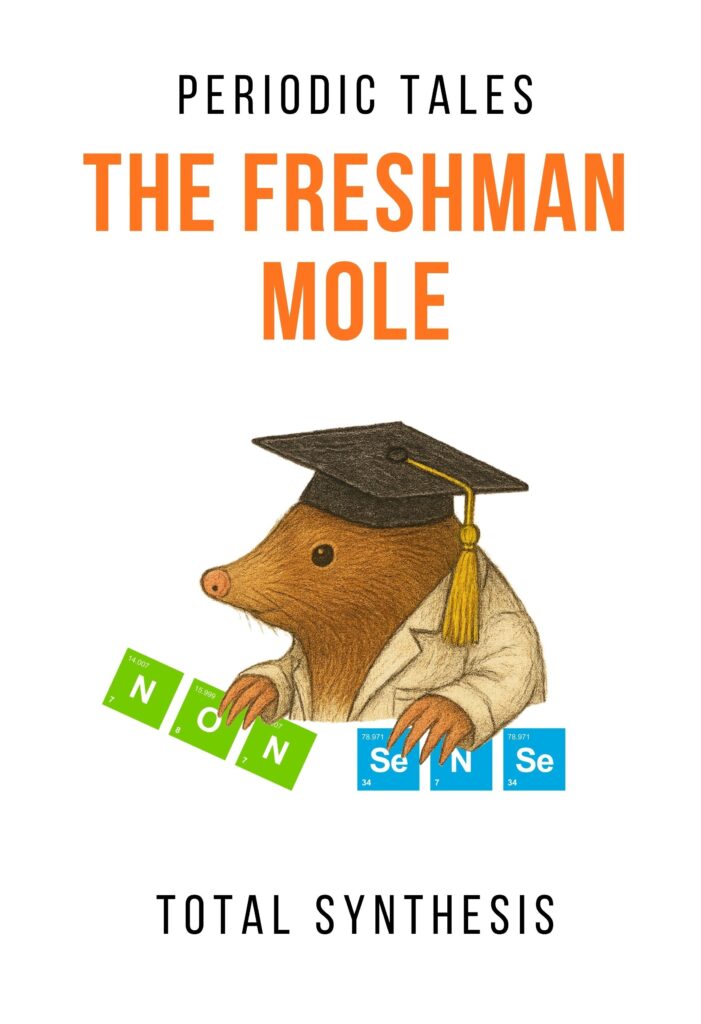
If you’re looking for a book that is not educational at all, check out “Periodic Tales – The Freshman Mole”.
Dedicated to every chemistry and STEM student who asked: “Why did no one warn me?”