Tag: Named Reactions in Organic Chemistry

  • Strecker Amino Acid Synthesis Mechanism & Examples

    Strecker Amino Acid Synthesis Mechanism & Examples

    Strecker synthesis to make amino acids from aldehydes and amines

    🫡 Here’s what you’ll learn in this article about the Strecker synthesis:

    👀 Left: 3D structure of phenylalanine, an amino acid easily obtained with the Strecker synthesis!

    Why is the Strecker synthesis important?

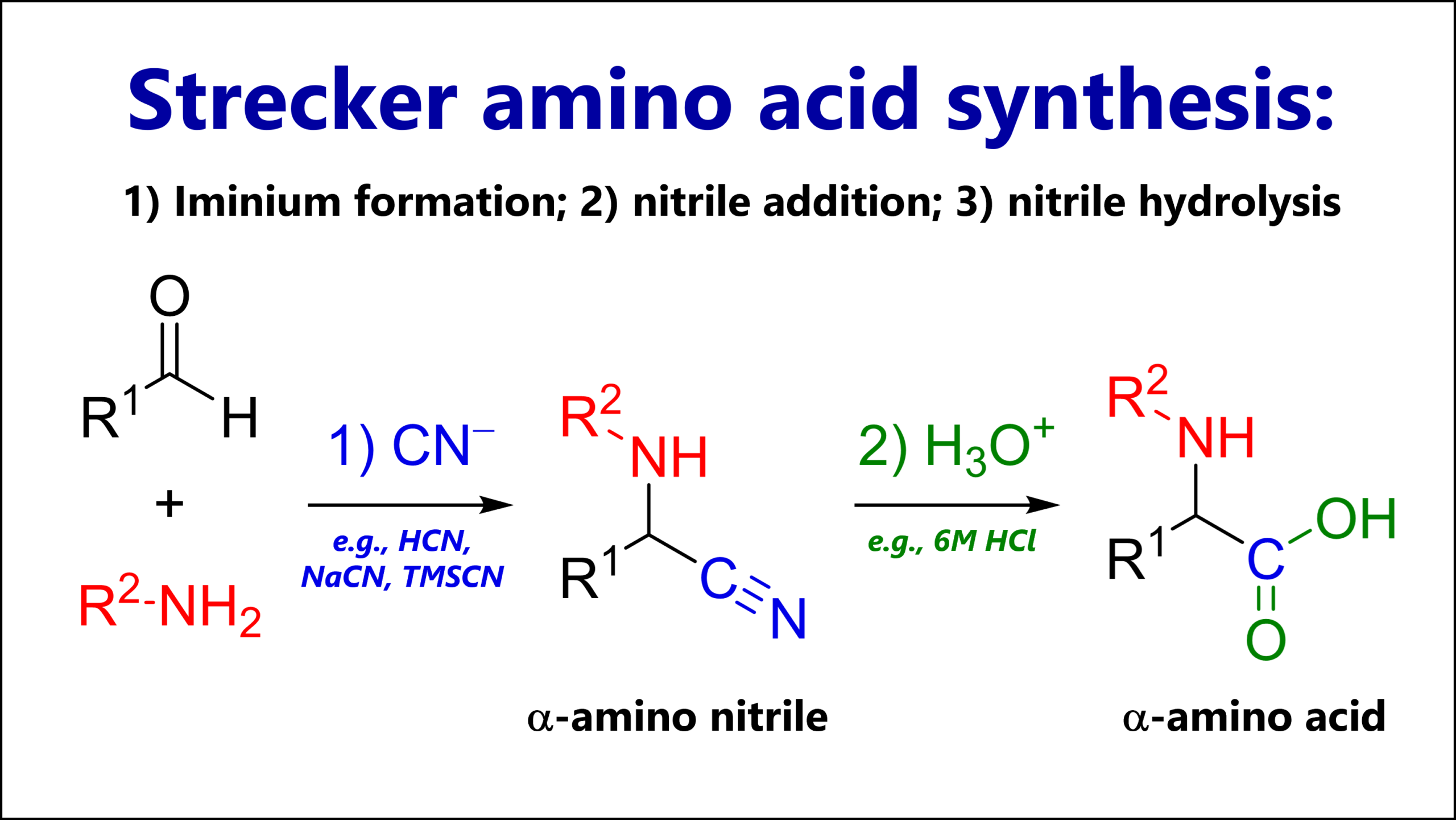
    Because it’s part of your exam. Jokes aside – the Strecker synthesis is one of the oldest but most powerful reactions in organic chemistry. It uses three components with simple functional groups – an aldehyde, an amine, and cyanide – to create α-amino nitriles and ultimately α-amino acids. This reaction might have been how amino acids were first formed on primordial Earth billions of years ago!

    Strecker synthesis mechanism

    The reaction mechanism of the Strecker synthesis follows three steps:
    1A. Condensation of ammonia or an alkyl amine (nucleophile) with a carbonyl, most commonly an aldehyde (electrophile), giving an iminium cation
    1B. Nucleophilic attack of cyanide (nucleophile) to the iminium (electrophile), giving an α-amino nitrile
    2. Typically in a second experimental step: Acidic hydrolysis of the nitrile functional group, giving a carboxylic acid.
    As we will see below, this is not the only thing we can do with the nitrile.
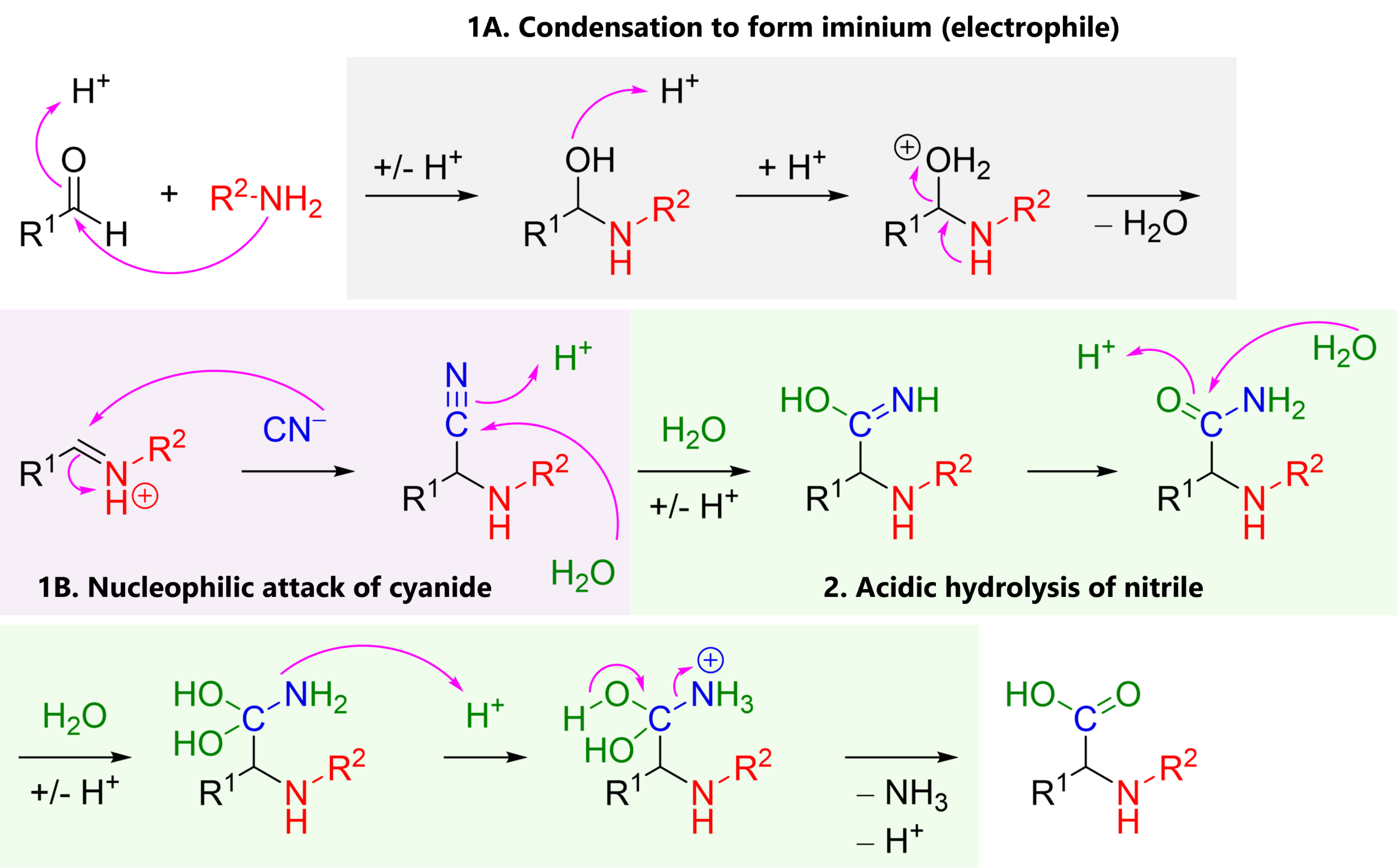
    Electron pushing mechanism of the Strecker amino acid synthesis

    This is a polar mechanism (think: electrophile-nucleophile).
    If the additions, protonations … are confusing, I suggest you look at your textbook’s chapter on carbonyl reactivity.

    Also, remember that the CN anion is called cyanide, but once it’s bound to carbon, the R-CN group is called a nitrile. In the Strecker synthesis, cyanide is a one carbon equivalent; a way to add one carbon into a molecule.

    Conditions for Strecker amino acid synthesis

    To achieve steps 1A and 1B, a range of reagents can be used. The classical conditions are NH3 + HCN, but HCN is extremely toxic and ammonia gas is not practical. Other cyanide sources like NH4Cl or NaCN + AcOH are safer and more practical, but just make sure you know the conditions mentioned in your lecture. Additional additives can include Lewis acids, to facilitate nucleophilic attack to the condensation product.

    The classical conditions for step 2 are HCl + H2O with heat. This is rather harsh, because nitriles are very stable. To avoid side reactions with other functional groups in the molecule, chemists sometimes also use alternative conditions for this step.

    I note some exemplary experimental procedures at the end.

    Simple Strecker synthesis examples

    Let’s get into some concrete examples: three easy, and two hard ones.

    I. Synthesis of phenylalanine

    The first is very simple – it’s the synthesis of phenylalanine, the molecule whose 3D model is shown at the start. Remember that the amino nitrile and amino acid are formed as a racemates (1:1 mixture of enantiomers) because after addition of the cyanide, the carbon has four different substituents.
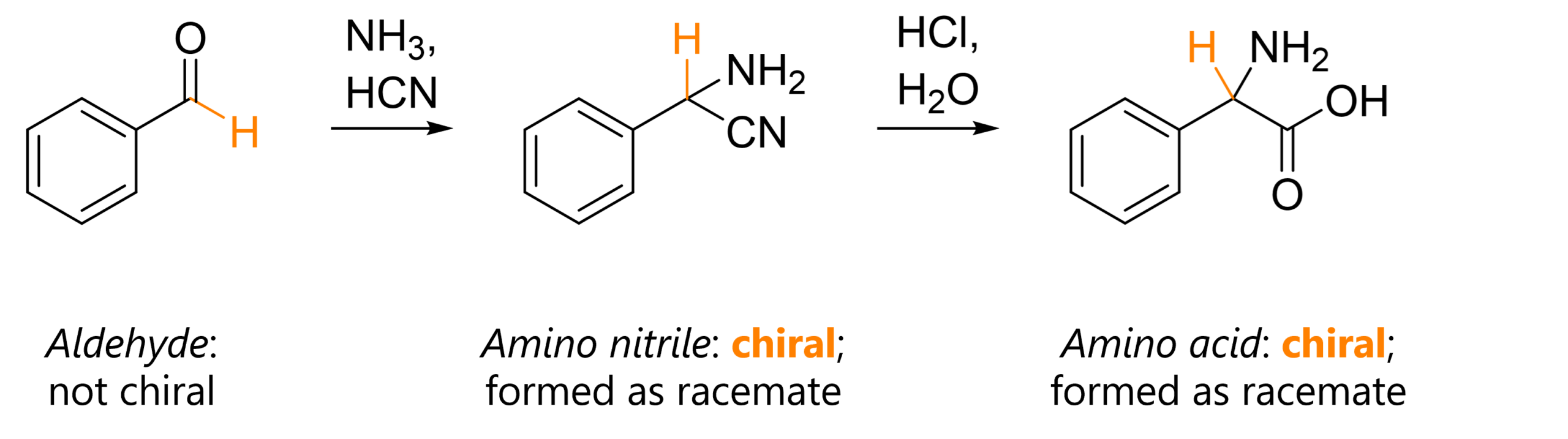
    Strecker synthesis of phenylalanine

    II. Synthesis of unnatural amino acids

    The second example is the first step of the synthesis of the unnatural amino acid methylvaline [4]. This example shows you that we can also use ketones, not just aldehydes, in Strecker syntheses. The difference is that that the central carbon is quaternary without a hydrogen substituent.

    This reaction was done on a kilogram scale (see procedure below), so we can appreciate that NaCN was used instead of HCN. Later on in the synthesis, the racemate is separated into the two enantiomers, and the nitrile is hydrolyzed (not shown).

    III. Reduction of amino nitriles

    The next example shows that our first synthetic intermediate, the α-amino nitrile, can also be used for other reactions [5]. Instead of acidic hydrolysis, the nitrile can also be reduced to the amine with lithium aluminium hydride.
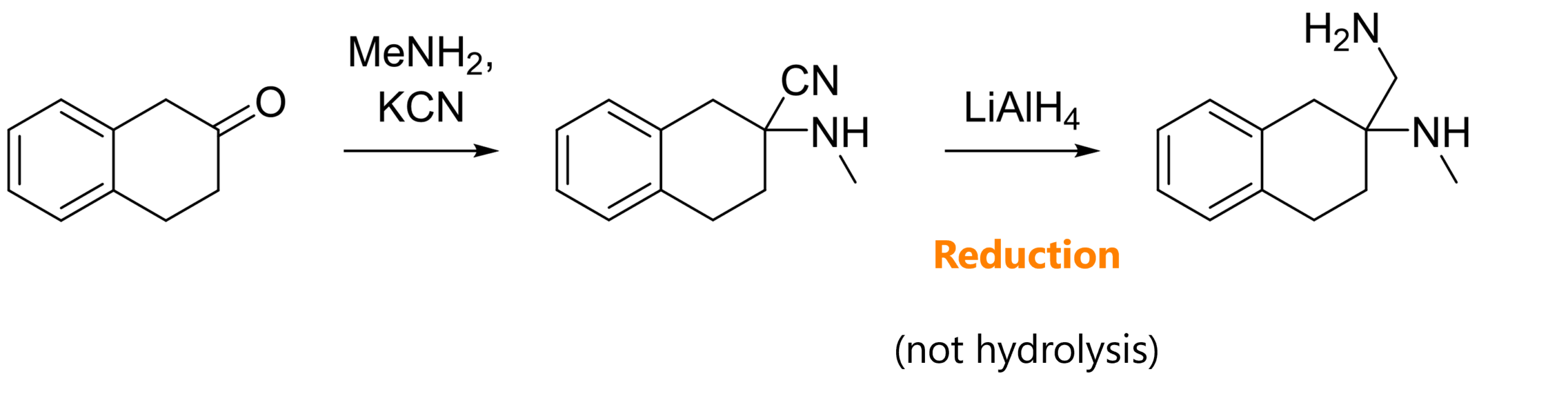
    Alternatively, you might also see reductions with DIBAL-H to the aldehyde, or nucleophilic additions of Grignard reagents.
    Tired of serious chemistry?
    Take a break with “Periodic Tales – The Freshman Mole”, a satirical novel that’s the opposite of educational.

    Dedicated to every chemistry and STEM student who asked: “Why did no one warn me?”

    Advanced Strecker synthesis examples

    The next two examples are more complex, intended for more advanced readers.

    I. Lurbinectedin: Intramolecular Strecker synthesis

    Can you figure out what’s happening in these three steps?

    Strecker synthesis en route to lurbinectedin

    This example comes from a synthesis of lurbinectedin [6], an alkaloid natural product which is lung cancer treatment. The reaction sequence is:
    1. Swern oxidation of the alcohol to the aldehyde;
    2. Acidic deprotection of the Boc-amine, followed by intramolecular condensation to the aldehyde and addition of cyanide;
    3. Deprotection of the benzyl protecting groups.

    This example shows you that instead of adding ammonia or amines, a Strecker synthesis can also occur with nucleophilic amines already present in our starting material.

    II. Flavisiamine F: No Condensation step

    Our final example shows that our starting material electrophile might already come as an imine, and not as an aldehyde or ketone.

    It also shows that chemistry can be quite complicated.

    Why is CH(CN)2OAc used as the cyanide source?
    Well, the chemists used this reagent because it was supposed to give the acyl cyanide, and finally the methyl ester product. In this case, they only obtained the nitrile (so they had to convert it with additional steps).

    Here’s how the reagent should work in theory.
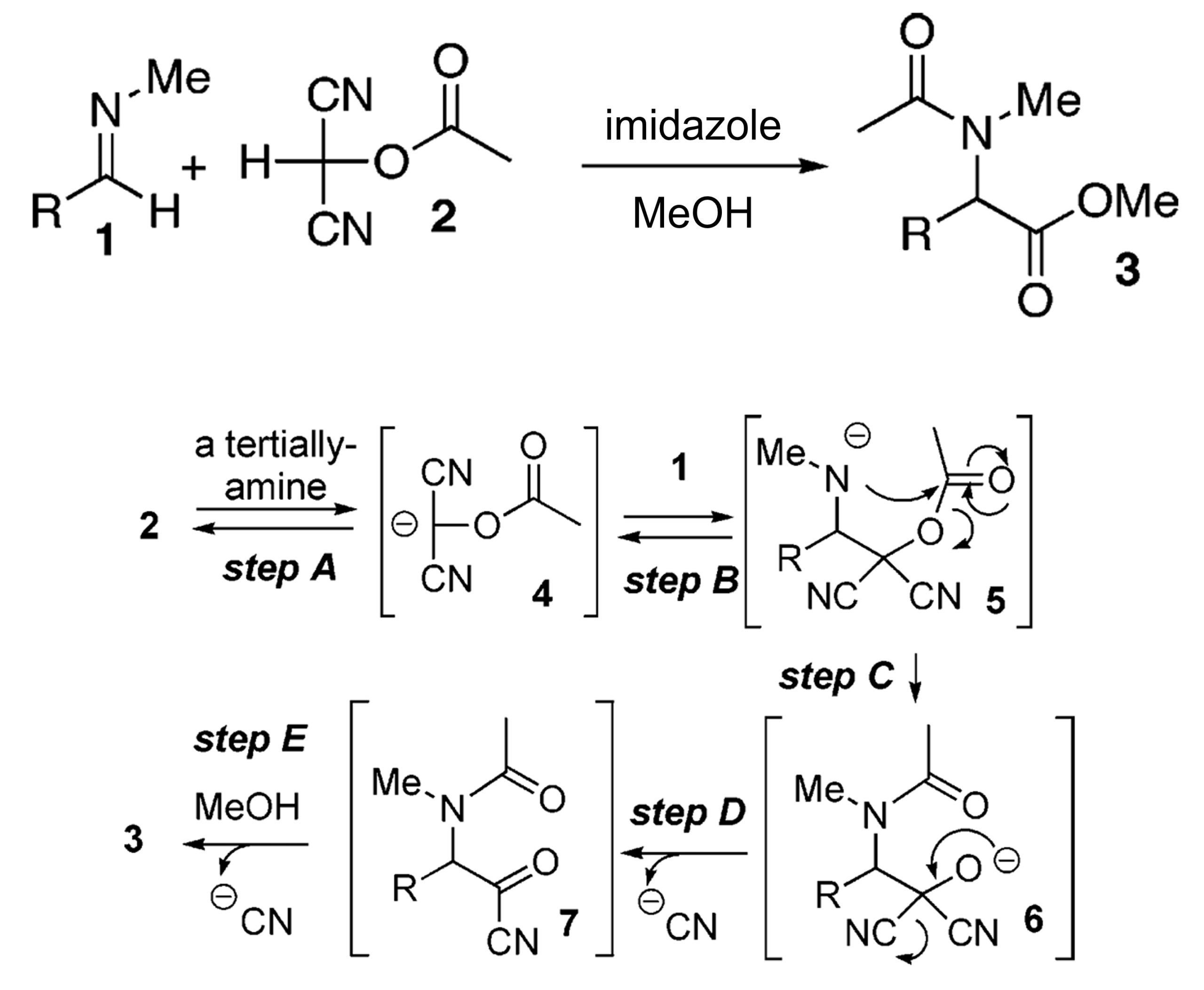
    Dicyanomethyl acetate as a nucleophile to give α-(N-methyl-N-acetyl)amino acid methyl esters

    Pretty amazing (and confusing) that an unexpected side reaction occurs with 88% yield!

    Diastereoselective Strecker Synthesis

    Initially, we mentioned that “normal” Strecker reactions deliver racemic mixtures of amino acids. There are two cases where this does not happen.

    The first is diastereoselectivity [9].
    When our starting material already comes with a chiral center, the nucleophilic attack of cyanide will often prefer one approach over the other (because one side will be sterically blocked).
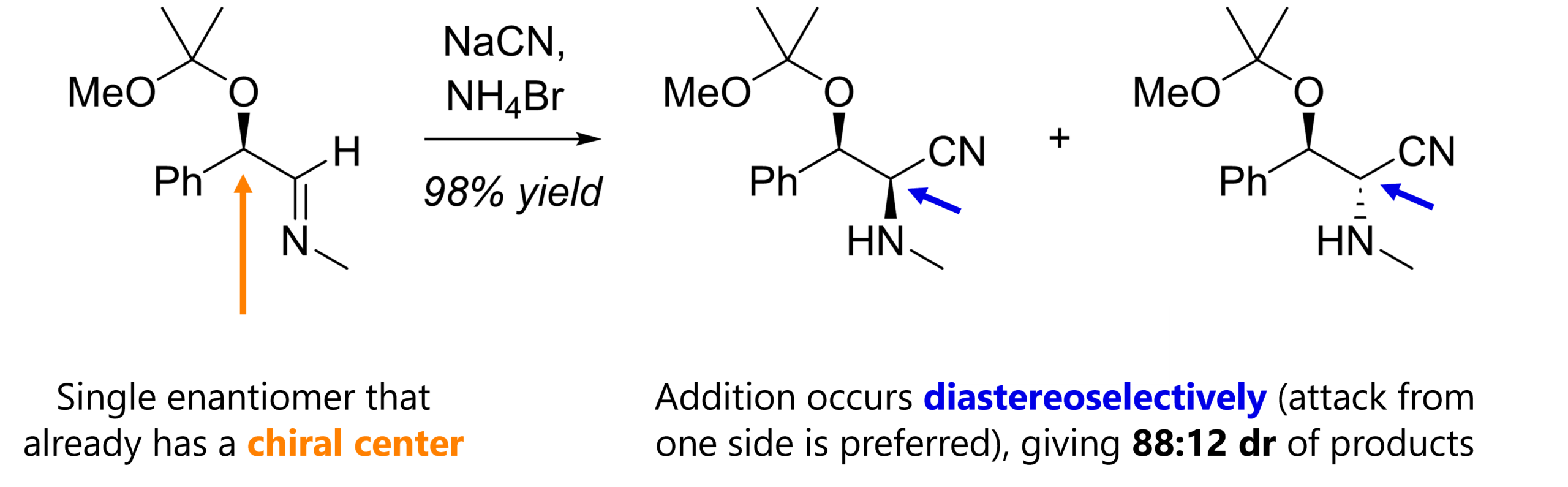
    Diastereoselective Strecker synthesis using a chiral auxiliary

    What I find really funny is that chiral amino acids themselves can be used as chiral auxiliaries! Below is a diastereoselective Strecker synthesis with (R)-phenylglycine amide. [9]

    But beyond auxiliaries, we can observe diastereoselective reactions in any chiral starting material. Here’s an example of a perfectly diastereoselective Strecker reaction [9].
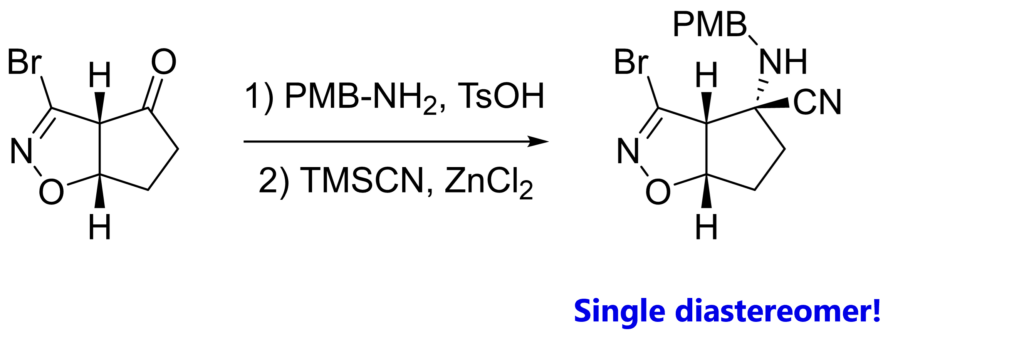
    Highly diastereoselective Strecker synthesis

    It’s all about how our starting material looks like in space. Let’s look at the 3D model.

    With both hydrogens facing “up”, the very same top / convex face of the carbonyl is more accessible than the bottom / concave face. Our cyanide anion will try to avoid repulsion with the electron pairs of N, O and Br. (obviously, we also have condensation first, prior to nucleophilic attack)

    Enantioselective Strecker Synthesis

    The second way to obtain non-racemic products is the use of a chiral catalyst for enantioselective Strecker synthesis.

    As just one example [9], below you see a catalyst system based on a titanium(IV) as a Lewis acid, a chiral biphenol ligand and a chiral cinchona alkaloid.
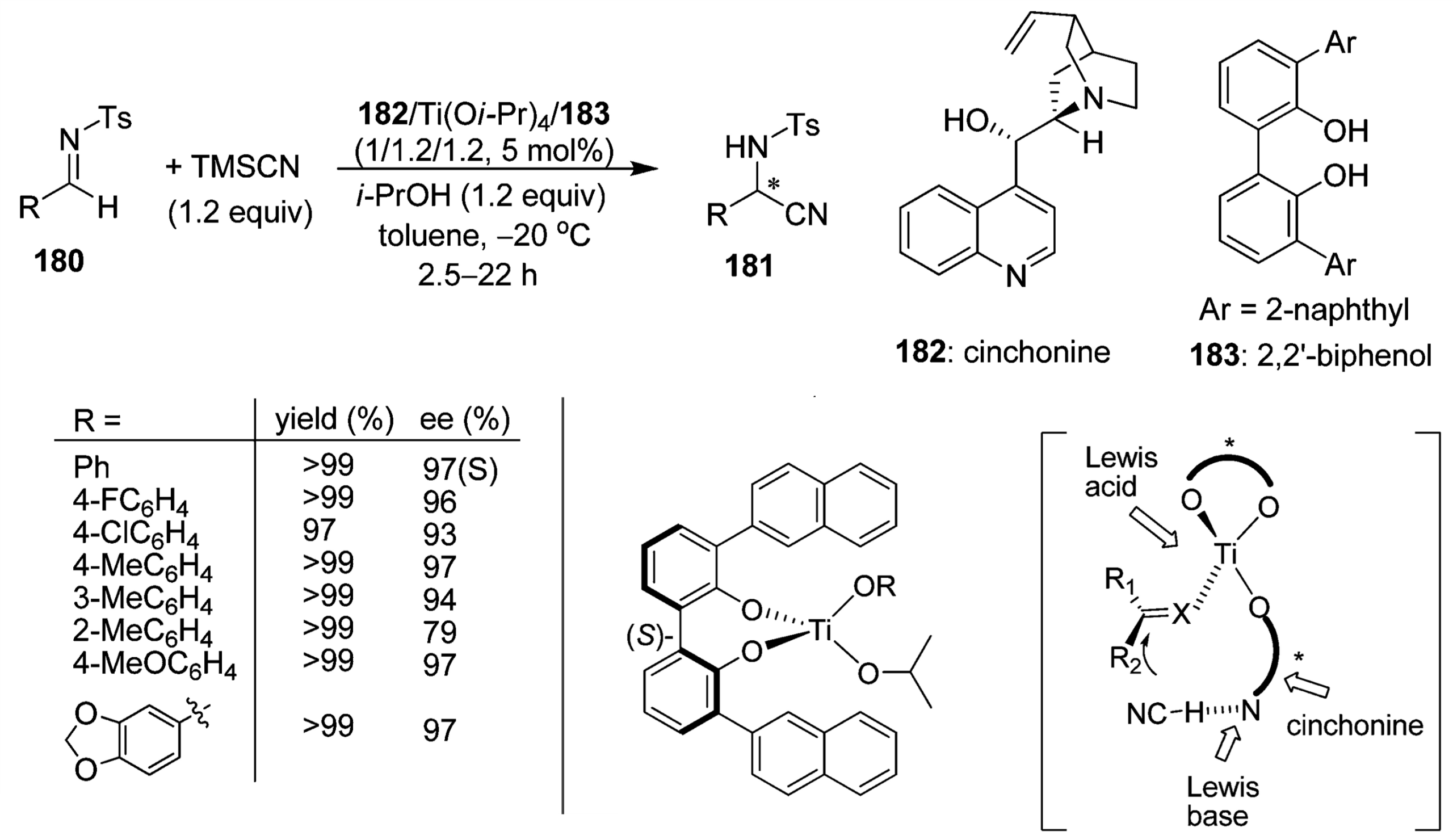
    Chiral catalyst for enantioselective Strecker synthesis

    This is a “bifunctional” activation. Ti(IV) increases the electrophilicity of the carbon, while the cinchonine alkaloid base increases the nucleophilicity of cyanide. This is because the active cyanide reagent in the catalytic cycle is in fact HCN (and not TMSCN). Pretty surprising! The ligands create a chiral environment around the electrophile, thus leading to very high ee (enantiomeric excess).

    Many other catalysts have been discovered.

    History of the Strecker synthesis

    I thought we wrap up with general context on this reaction. It goes way back. It’s named after the German chemist Adolph Strecker. This guy was a student of Justus von Liebig, one of the principal founders of organic chemistry.

    Strecker first reported the reaction way back in 1850, making alanine from acetaldehyde, ammonia and HCN [1][2]. In his paper, he wrote:“The larger crystals of alanine are mother-of-pearl-shiny, hard and crunch between the teeth.” 😂

    Notably, the first documentation of this reaction was even earlier, in 1838, by chemists Laurent and Gerhardt [3] (you see, you don’t always need to be first to have a reaction named after you).

    This makes it the first multicomponent reaction in organic chemistry. In comparison, the Petasis reaction (another multicomponent reaction to prepare amino acids) is much younger, having been reported only in 1993.

    Strecker was quite the productive chap. He also discovered the Strecker degradation (oxidative decarboxylation of α-amino acids) and the Strecker reaction (synthesis of alkyl sulfonates) – not to be confused with the Strecker synthesis of amino acids.

    This is it for this article. Feel free to check out other articles on my page or my educational videos!

    Classical Strecker synthesis: Synthesis of Alanine [10]

    “131 g (3 mol) of freshly distilled acetaldehyde is added to 100 cc. of ether in a 2-l. bottle and cooled to 5 °C in an ice bath. 180 g (3.4 mol) of ammonium chloride dissolved in 550 cc. of water is then added, followed by an ice-cold solution of 150 g (3.1 mol) of NaCN in 400 cc. of water. The sodium cyanide must be added slowly and with frequent cooling to prevent loss of acetaldehyde by volatilization. After the sodium cyanide solution is added, the bottle is stoppered securely, placed in a mechanical shaker, and shaken for four hours at room temperature. At the end of this time the solution is transferred to a 3-l. distilling flask and 600 cc. of concentrated hydrochloric acid is added. […]”

    Strecker synthesis with HCN experimental procedure [11]

    “A solution of imine (0.2 mmol) and chiral catalyst (4.0 μmol) in methanol (1 mL) under a positive pressure of nitrogen was cooled to -25 °C. Liquid HCN (2.0 mmol) was added dropwise by chilled syringe to the solution, which was stirred at -25 °C for 12 hours and warmed to room temperature. Methanol and excess HCN were removed by evaporation, water (3 mL) was added and extracted with ether (3 mL). After drying (MgSO4), the organic layer was evaporated to afford the crude amino nitriles.

    The amino nitrile (1.0 mmol) was suspended in 6.0 N HCl (1.0 mL) and heated to 60 °C. After 6 h, the reaction was cooled and washed with diethyl ether (2 x 1 mL). The aqueous layer was then neutralized with saturated ammonium hydroxide and the amino acid collected as a crystalline solid by filtration.”

    Large-scale Strecker synthesis experimental procedure [4]

    “In a 75 L round-bottom flask equipped with a mechanical stirrer, condenser, and thermocouple was added 2.79 kg (23.2 mol) of MgSO4, 1.24 kg (23.2 mol) of NH4Cl, and 2.16 kg (44.1 mol) of NaCN. The solids were slurried in 26.5 L (185.6 mol) of 7 M NH3 in MeOH and cooled to −5 to −10 °C. The internal temperature of the slurry was −5 °C and rose to 8 °C after stirring for 10 min as some of the solids dissolved. To the resulting suspension was added in one portion (4.00 kg, 46.4 mol) of 3-methyl-2-butanone 4. The internal temperature slowly rose from 8 to 35 °C over the course of 1 h, at which point it slowly decreased to 30 °C and was held at this temperature for 3 h (total reaction time 4 h). The reaction was judged complete by GC analysis at this point. […]. The final 1H NMR assay was 4.3 kg of 5 (87%).”

    Strecker amino acid synthesis References

  • Robinson Annulation Mechanism & Examples

    Robinson Annulation Mechanism & Examples

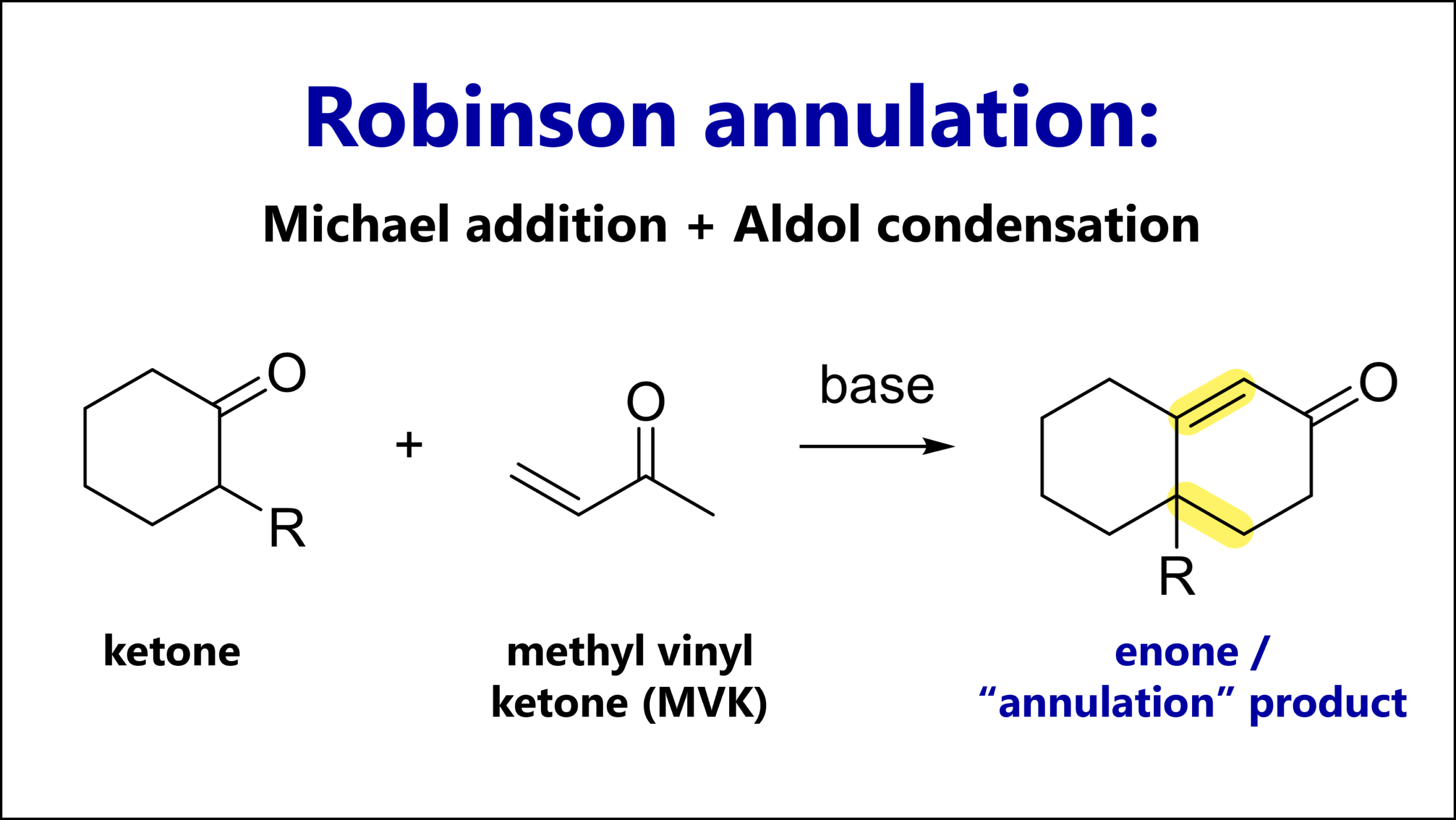
    Robinson annulation reaction to give cyclized alpha,beta-unsaturated ketone products

    🫡 What you’ll learn in this Name Reaction article:

    what are the two starting materials for a robinson annulation?

    The Robinson annulation requires an enolizable ketone (Michael donor) and an α,β−unsaturated ketone (Michael acceptor), typically methyl vinyl ketone (MVK).
    The last important component is catalytic base (or less often, acid). To achieve all sub-reactions in one step, stoichiometric base is often used.

    Robinson annulation mechanism

    The Robinson annulation is a C-C bond forming reaction, and also a cyclization reaction (by the way, an annulation is simply the fusion of a new ring to a molecule through two new bonds).

    The mechanism consists of three steps:
    1) Michael addition, also called conjugate or 1,4-addition
    2) Intramolecular Aldol addition
    3) Dehydration to give the enone ring, making 2) + 3) an Aldol condensation)

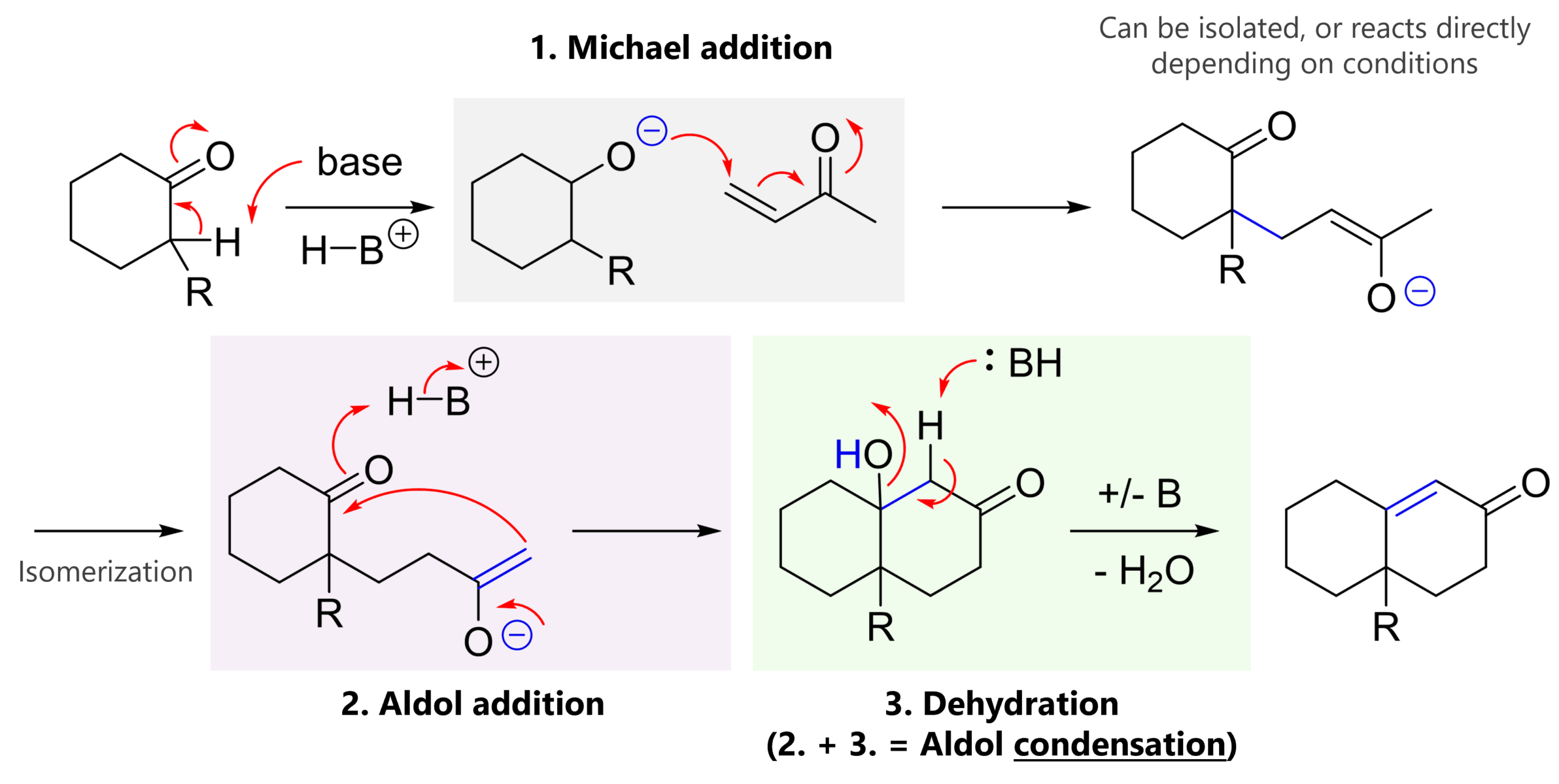
    Reaction mechanism for the Robinson annulation reaction

    The first step is deprotonation at the alpha-position of the carbonyl (here, cyclohexanone) to give an enolate. Remember, this position is relatively acidic due to its resonance stabilization. This is why we need base catalysis!
    Note: Starting material and conditions can influence on which side the enolate forms (e.g., think R = -CO2Me vs. tBu). Know your thermodynamic vs. kinetic enolates!

    This enolate is a nucleophile, so it attacks our electrophile (here methyl vinyl ketone). This forms one of the two carbon-carbon bonds.

    Depending on the specific case, we can either i) isolate this product and then perform the Aldol condensation, or ii) the product continues directly. The easiest way to draw this is to simply assume that the product isomerizes to the reactive enolate (you can also draw two intermediate steps where the enolate is first protonated, and then again deprotonated from the other side).

    You will know that intramolecular reactions are very efficient (pre-organization and proximity of reactive partners). The Aldol reaction is an attack to our internal ketone, forming the second carbon-carbon bond.
    The 3D model helps visualize how the side chain can orient itself in a way where the nucleophilic enolate gets close to the electrophilic ketone.

    Finally, water is eliminated (E1cb) to give the conjugated enone product. This makes steps 2 and 3 an Aldol condensation. This final step can require more forcing conditions (low temperatures are fine for Michael and Aldol additions, but not always for elimination).

    Robinson annulation Watchouts

    • The reaction is useful if the starting material ketone and enone are simple (because we would get fewer side reactions / higher yield) or readily available (because we would care less about yield). To manage complex cases, chemists have developed modifications of the reaction.
    • Methyl vinyl ketone can polymerize and thus, other “MVK equivalents” have been developed for practical reasons (see later section)
    • The reaction can be done in one step or alternatively two (isolation of the Michael addition product). Note that our initial Michael addition product, does not immediately cyclize to the ketone. This would form a four-membered ring which is much less favored than the six-membered ring that can be formed once the other enolate is formed.
    • The reaction is typically base-catalyzed, but there are also examples of acid-catalyzed variants (e.g., H2SO4).
    • We can use the carbonyl and double bond in the product for further reactions which is why people call such groups “synthetic handles”. The reaction has been widely used, particularly for the synthesis of steroids.

    Robinson Annulation conditions

    As mentioned, the Robinson annulation often uses catalytic amounts of base. For the one pot reaction, commonly used bases are hydroxide bases (e.g., KOH) or alkoxide bases (e.g., NaOMe, KOtBu). Sometimes, stoichiometric use of stronger hydride bases (e.g., NaH) is used. The stepwise method often uses different conditions, like a cat. hydroxide base for Michael addition, followed by an amine base like piperidine for the intramolecular Aldol condensation.

    For exemplary reaction conditions, please see the experimental procedures at the end of the article.

    Tired of serious chemistry?
    Take a break with “Periodic Tales – The Freshman Mole”, a satirical novel that’s the opposite of educational.

    Dedicated to every chemistry and STEM student who asked: “Why did no one warn me?”

    History of the robinson annulation

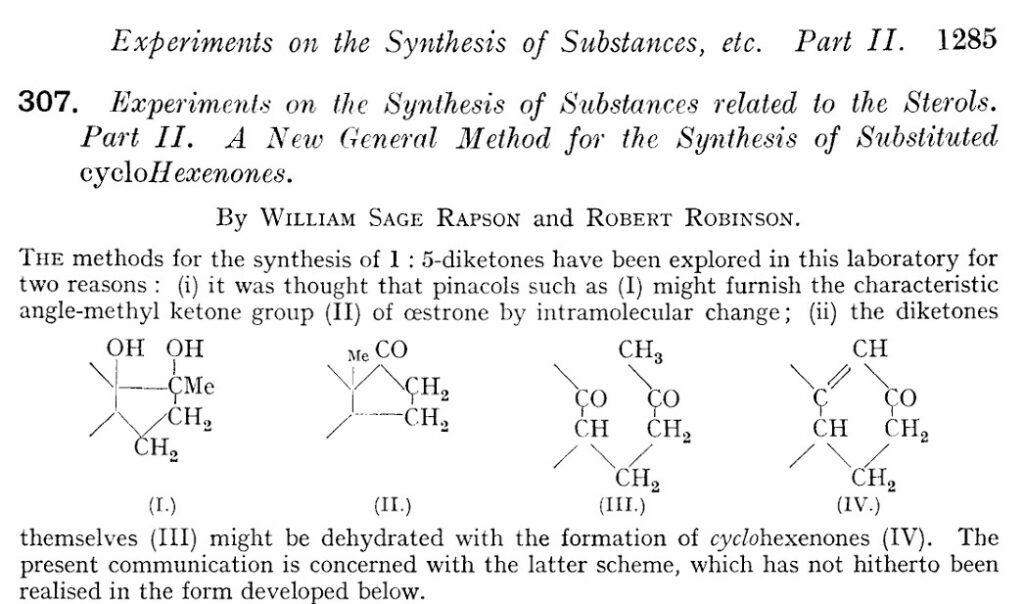
    Before we get into examples, just some historical context. I hope you will not be shocked that the Robinson annulation was developed by the British organic chemist Robinson. Together with Rapson, they reported the method for the first time in 1935 [1]. They performed the reaction in a step-wise manner, using sodium azide (NaNH2) as the base.

    Rapson and Robinson seminal 1935 publication

    Robinson is well known for finding a one-pot synthesis of tropinone, inventing the use of curly arrows to show electron movement in reaction mechanisms, structural determinations like morphine, penicillin and strychnine. He received the Nobel prize in 1947.

    Here’s a fun story: Robinson reported the total synthesis of cholesterol using his annulation reaction in 1951 – around the same time as R. B. Woodward – the OG of organic chemistry.

    In Name Reactions, Fourth Edition, Jie Jack Li wrote: Here is a story told by Derek Barton about Robinson and Woodward.

    “By pure chance, the two great men met early in a Monday morning on an Oxford train station platform in 1951. Robinson politely asked Woodward what kind of research he was doing these days; Woodward replied that he thought that Robinson would be interested in his recent total synthesis of cholesterol. Robinson, incensed and shouting ‘Why do you always steal my research topic?’, hit Woodward with his umbrella.
    —An excerpt from Barton, Derek, H. R. Some Recollections of Gap Jumping, American Chemical Society, Washington, D.C., 1991.

    robinson annulation examples

    Let’s get into three concrete examples.

    #1 The first example is so famous that the product even got its own name – the Wieland-Miescher ketone [2]. This is a case of a Robinson annulation under acidic conditions.

    Synthesis of the Wieland Miescher ketone through a Robinson annulation reaction

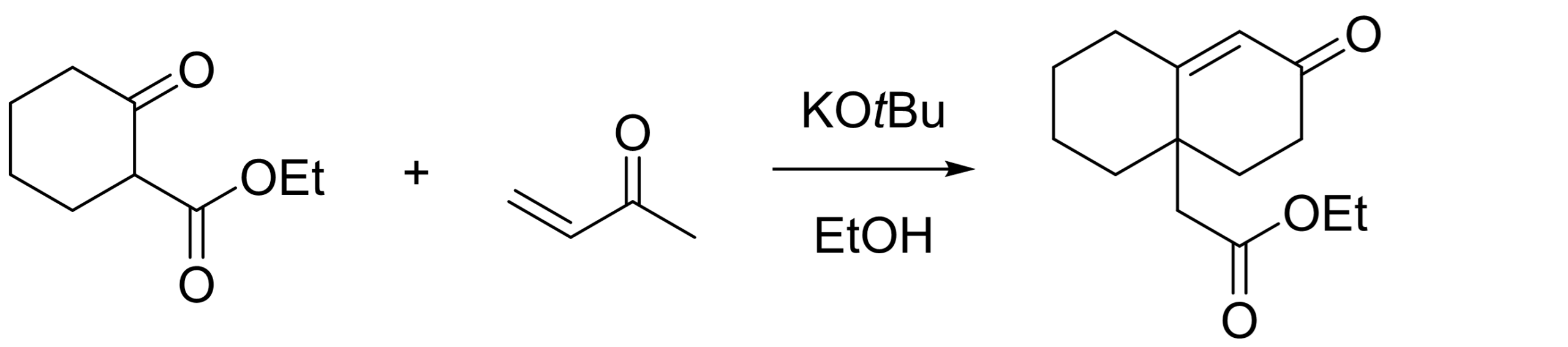
    #2 In this next example, the R group is just an ethyl ester. This obviously makes the reaction very efficient because the starting material is a great Michael donor / easily enolizable.

    Example of a Robinson Annulation reaction with a substituted ketone

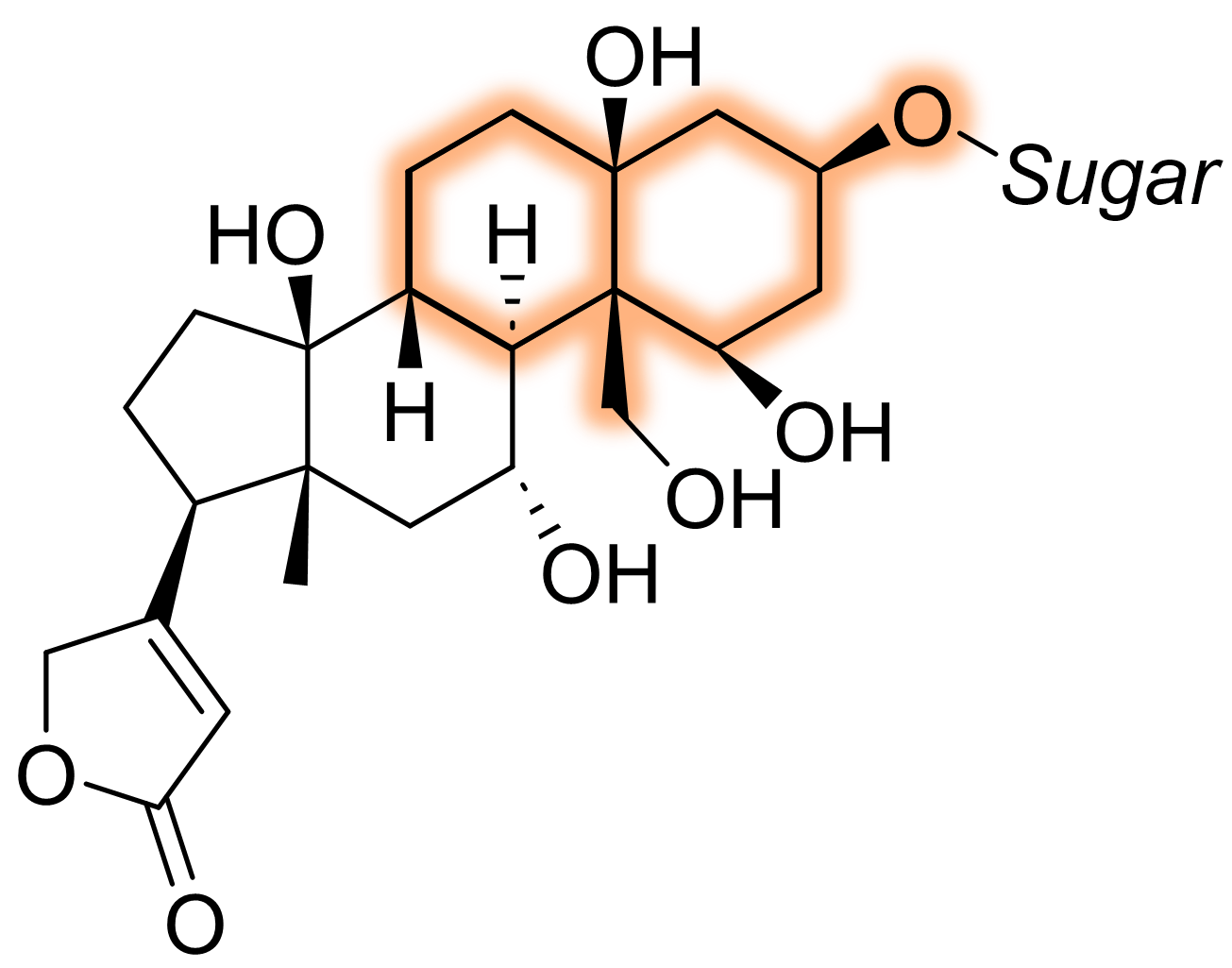
    The product was intended to be used for the synthesis of ouabain, a glucoside steroid [3]. You can quickly see where the 6/6-bicyclic ring would fit.

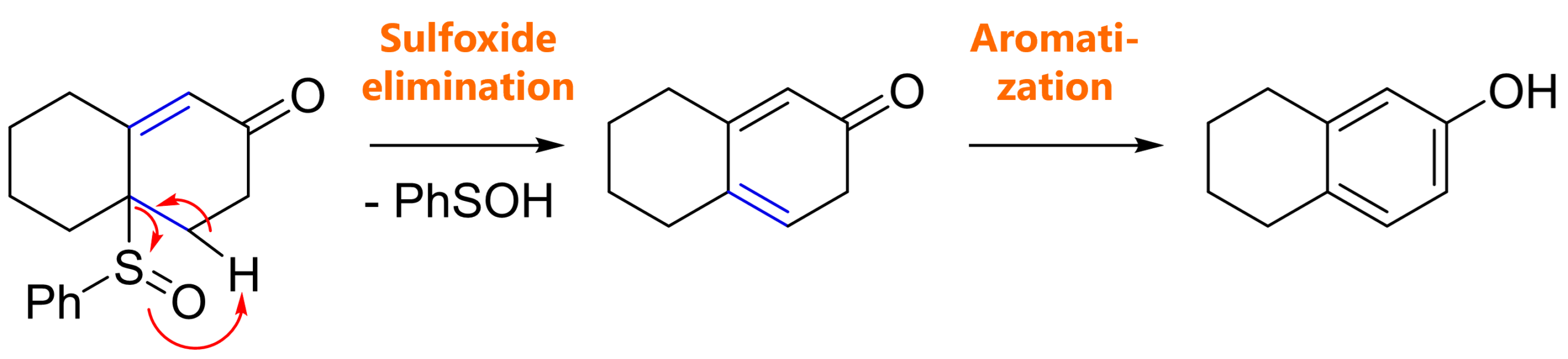
    #3 What about this next example – can you explain the formation of the product if our starting material has a sulfinyl group? [4]

    Robinson annulation example based giving an aromatic product

    We obviously form a bicyclic annulation product as expected, but we also lost the sulfinyl group. This is because after Robinson annulation, elimination of phenyl sulfenic acid gives cyclohexadienone which can aromatize to the phenol.

    Mechanism of Robinson annulation with sulfoxide elimination

    robinson annulation with different michael acceptors

    How does the above differ versus our next example [5]? This is actually from a 1950 report of the legendary R. B. Woodward!

    Robinson annulation with alkynone as Michael acceptor

    Now, our Michael acceptor is an alkynone with a triple bond. This means that after the Michael addition, we’re left with a double bond (instead of the usually remaining single bond). The Aldol condensation happens as expected. Without any other substituent on the ring, you’d also expect enolization of the ketone group to the phenol (as we saw in example #2). However, we have a methyl group in our starting material, so the aromatization is impossible!

    robinson annulation with Methyl vinyl ketone equivalents

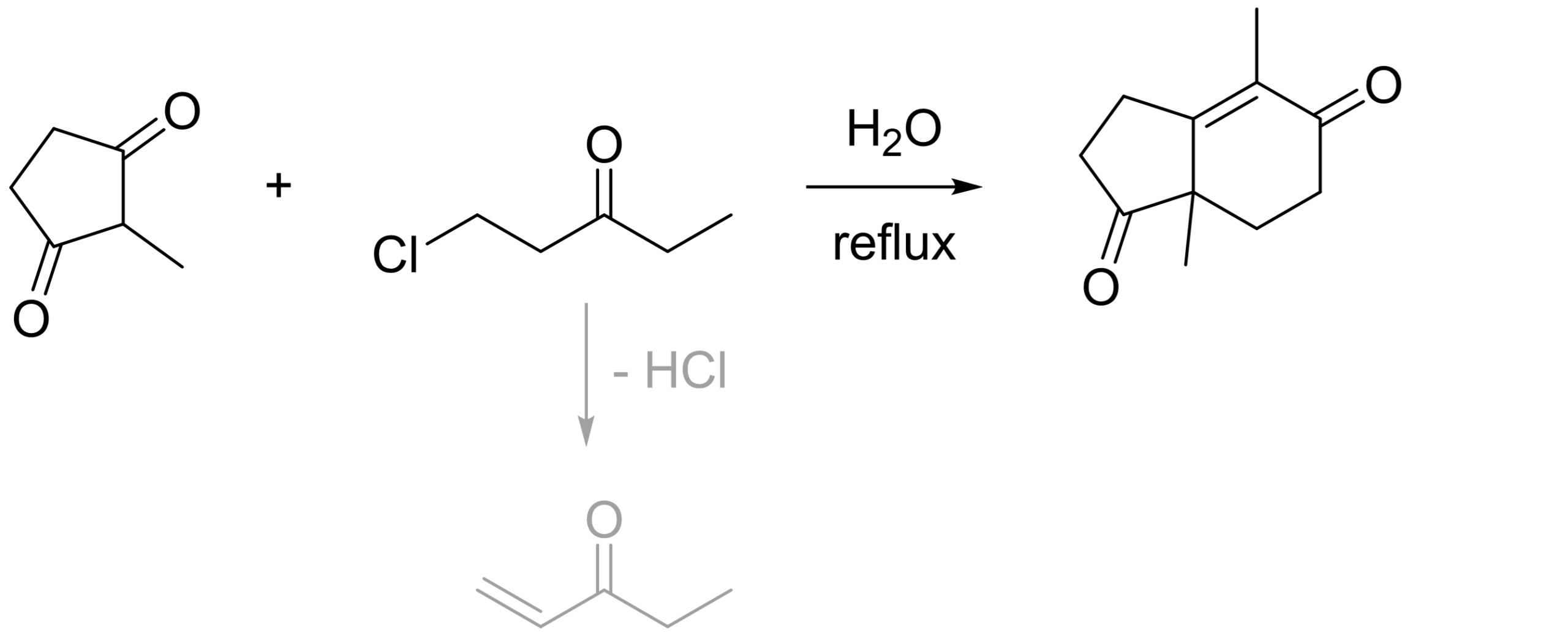
    As already mentioned, enones like methyl vinyl ketone can suffer from polymerization and other side reactions. Precursor compounds like β-chloroketones or β-ammoniumketones can be used instead of enones [6].

    Beta-chloroketones as precursors for enones

    In this case, the HCl generated from the β-chloroketone acts as the catalyst for the Michael addition and Aldol reaction. So, this is again an acid-catalyzed example.

    Stereoselective robinson annulation reactions

    Like in most reactions, we can achieve stereoselective product formation with the right setup. There are two areas to explore: enantioselectivity and diastereoselectivity.

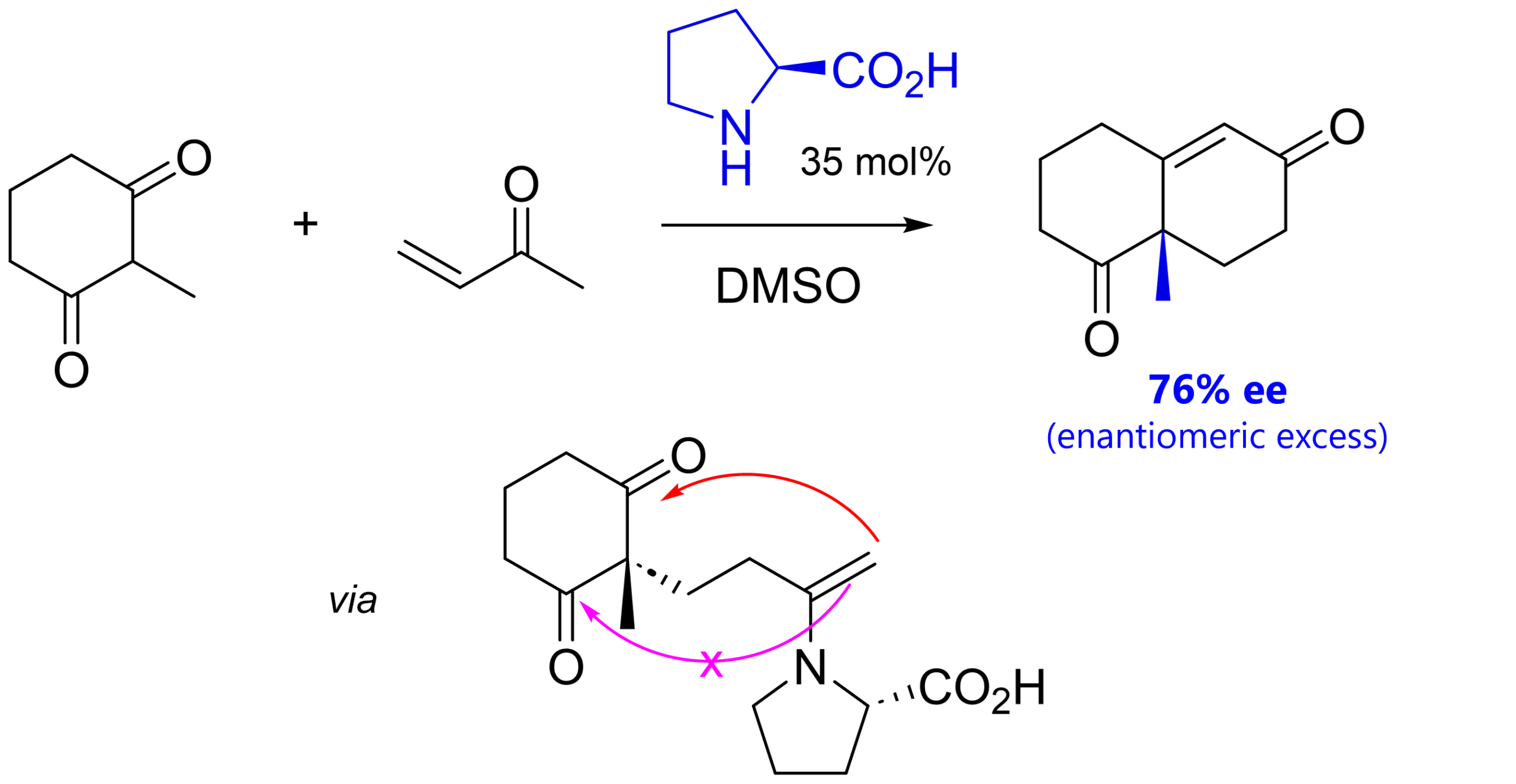
    The first logic is to use a chiral base to get enantioselectivity of one product over another one. The amino acid L-proline does just that! [7]

    Proline catalyzed Robinson annulation

    This enantioselectivity comes from the fact that, after Michael addition (which is also accelerated by proline), proline forms a chiral enamine prior to Aldol condensation. Due to proline’s chirality, attack on one of the two pro-chiral ketones is favored (there have been different transition state models proposed which you can look up if you’re interested [8]).

    Interestingly, it’s not just the stereochemistry of proline that plays a decisive role. Using a reduced proline, where the carboxylic acid is reduced to the alcohol, does not facilitate the final dehydration under the same conditions. The carboxylic acid can act as an intramolecular proton donor, making the elimination more efficient.

    Diastereoselective robinson annulation

    The second way that stereoselectivity can happen is through diastereoselectivity. This happens when our Michael acceptor and/or Michael donor come with additional substituents themselves. The two new C-C bonds can now be formed with some stereochemical bias (the explanation always depends on the specific case – e.g., kinetic / sterics vs. thermodynamic explanation).

    Here’s an example [8] where where our Michael donor has an ester group (nothing new!), and also our Michael acceptor has a silyl substituent in the β-position. In the product, both substituents end up at sp3-hybridized / tetrahedral carbons so we can expect different diastereomers forming. The observed ratio was 6:1 in favor of the cis-substituted product.

    Diastereoselective Robinson annulation reaction

    Thermodynamic control might explain the major diastereomer, as it allows the bulky silly group to occupy the equatorial ring position.

    Functionalization of Robinson annulation products

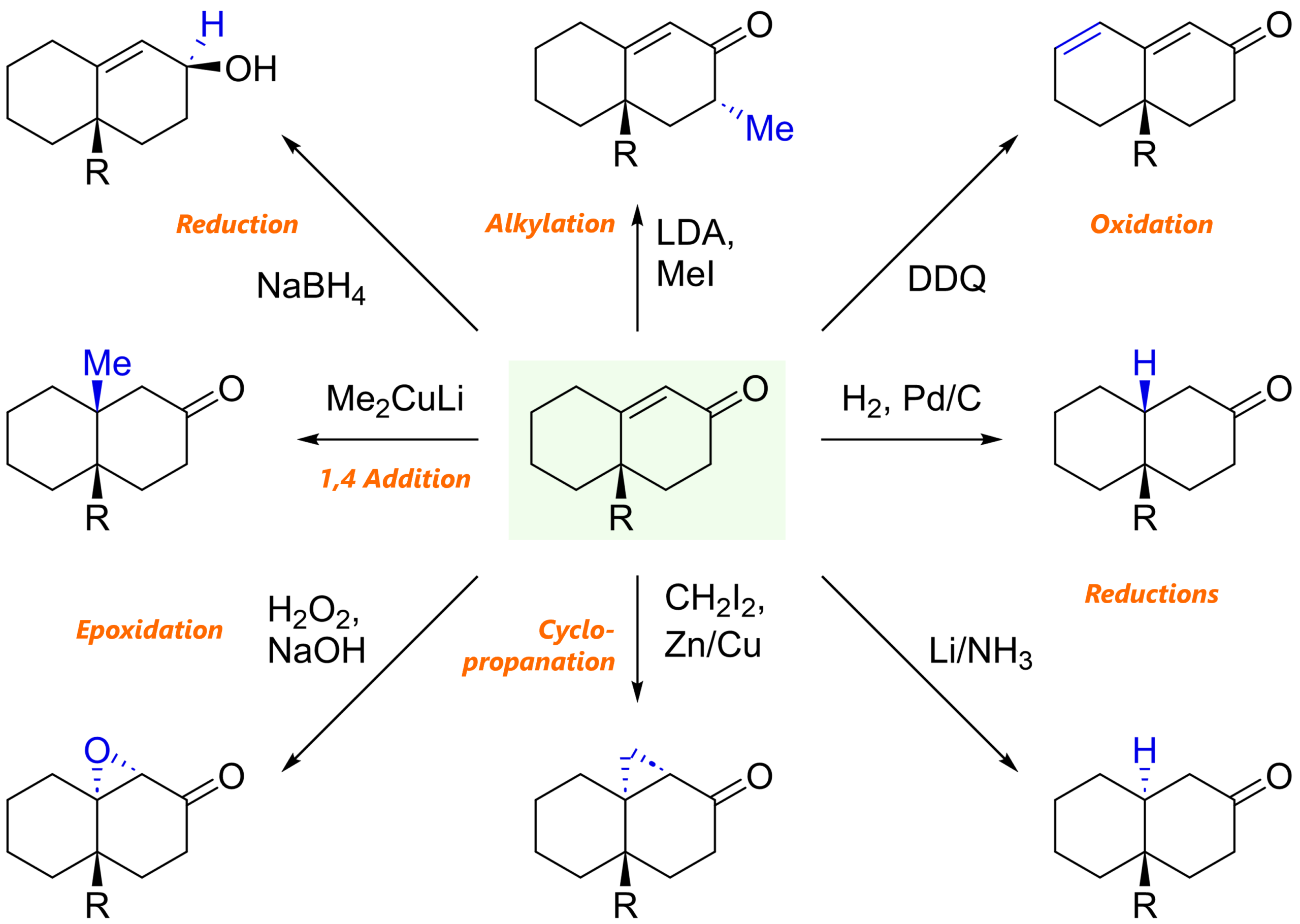
    We mentioned above that the annulation products can be pretty handy. This is an opportunity for you to test your organic reaction toolkit. What reactions do you know that might be applied to that bicyclic enone system?

    Here are some examples: nucleophilic addition, reduction, epoxidation, cyclopropanation – and even oxidation.

    Robinson annulation product as synthetic entry to functionalized bicyclic compounds

    That’s it for this article! Feel free to check out other articles on my page or my educational videos!

    Robinson annulation experimental procedure [2]

    Potassium t-butoxide (296 mg, 2.65 mmol) was dissolved in ethanol (EtOH, 25 mL) at 0 °C, under argon. After stirring for 20 min, ethyl 2-oxocyclohexanecarboxylate (8 mL, 50 mmol) was added slowly at the same temperature. After 15 min at 0 °C, methyl vinyl ketone (4.15 mL, 50 mmol) was added over 5 h via syringe pump. Then the resulting deep-orange solution was heated to reflux and kept for 6 h. The reaction mixture was cooled to ambient temperature. After stirring for 18 h, the mixture was poured into a separatory funnel containing saturated NH4Cl (30 mL) and extracted with Et2O (3 x 200 mL). The combined organic layers were dried over MgSO4 and solvent removal afforded 14 (11.0 g) as a crude orange oil, which was used without further purification.

    Robinson annulation experimental procedure [3]

    “A solution containing 2-(phenylsulfinyl)cyclohexanone (1.97 mmol, 439 mg)and sodium methoxide (0.21 mmol, 0.10 mL of 2.15 M methanolic NaOCH3) in 10mL of absolute methanol cooled to 0 °C under nitrogen was treated dropwise (20 min) with methyl vinyl ketone (2.76 mmol, 193 mg, 0.24 mL, 1.4 equiv) and the reaction mixture was stirred at 0 °C for 23.5 h. Additional sodium methoxide (2.36 mmol, 1.10 mL of 2.15 M methanolic NaOCH3) was added and the mixture was allowed to warm to 25 °C where it was stirred for 31 h. The resulting reaction solution was poured onto 5% HCl (25 mL) and the aqueous phase was extracted thoroughly with ether (5x 10 mL). The combined etheral layers were washed with saturated NaCl, dried (MgSO4),and concentrated in vacuo. Chromatography (10 to 25% ether-hexane gradient elution) afforded 168mg (291 theoretical, 58%) of pure phenol as a white solid.”

    Robinson annulation experimental procedure [7]

    “A solution of L-proline (0.32 g, 2.8 mmol) and 2-methyl-1,3-cyclohexadione (1 g, 7.7 mmol) in 50 mL of anhydrous DMSO was stirred under argon at 35 °C until the ketone and proline were completely dissolved. To this solution, freshly distilled methyl vinyl ketone was slowly added dropwise (0.99 mL, 11.9 mmol). The reaction was vigorously stirred at this temperature for 89 g and then quenched with ethyl acetate/saturated ammonium chloride. The organic layer and aqueous layer were separated with an addition of brine. The aqueous phase was filtered, and evaporated in vacuo. Crude product was purified by column chromatography.”

    Robinson annulation References

  • Diels Alder Reaction Mechanism, Orbitals & Examples

    Diels Alder Reaction Mechanism, Orbitals & Examples

    Overview of Diels Alder reactions giving endo and exo products

    The Diels Alder reaction is a [4+2] cycloaddition reaction between a conjugated diene and a dienophile. Here we explain its mechanism, orbital theory, stereoselectivity and endo rule using 3D models and examples.

    • Mechanism: The Diels Alder reaction is a concerted [4+2] cycloaddition of a diene in its s-cis conformation with a dienophile.
    • Selectivity: Diels Alder reactions can be regioselective and stereoselective. As there are no intermediates, they are also stereospecific.
    • Substituent effects: Normally, a nucleophilic, electron-rich diene reacts with an electrophilic, electron-poor dienophile. Resonance explains regioselectivity, while secondary orbital overlap explains the endo rule.
    • Orbitals: In the normal electron demand DA reaction, the diene’s HOMO reacts with the dienophile’s LUMO. A smaller energy gap (due to substituents, Lewis acids) increases reactivity.
    • Hetero Diels Alder reactions: Involve reactants with non-carbon heteroatoms
    • Inverse electron demand Diels Alder: Feature electron-poor dienes and electron-rich dienophiles.
    • Remember: DA is often the easiest way to synthesize 6-membered rings!

    1. reaction mechanism

    As the Diels Alder is a pericyclic reaction, it proceeds in one step / concerted.
    The diene, containing two conjugated alkenes, reacts with a dienophile which is usually an alkene or alkyne (the name means something that likes dienes; sorry, chemistry is strange). Both reactants are flat (double bonds and diene is conjugated) and approach each other in a face-to-face manner.

    Diels Alder reaction mechanism

    The driving force of the Diels-Alder reaction is the formation of two σ-bonds (σ-bonds are stronger than π-bonds) in the cyclohexene product. The four atoms linked to these sigma bonds all change from sp2 to a sp3 hybridization in the product.

    Diels Alder cycloaddition products are in the boat conformation

    Note that the cycloaddition initially gives the cyclohexene in its boat conformation. Try to really visualize how the transition state. If the dienophile approaches from the bottom (as drawn here; the alternative approach from the top is equally likely for achiral molecules), we form the boat conformation where the hydrogen that was previously pointing away from the diene, the Hexo, “looks up” (wedge in the product). As we see below, the reaction is stereospecific so both Hexo and Hendo in the diene retain their relative orientation (i.e., they look the same way in the product).

    The diene has to be in the s-cis conformation to react (bonds form simultaneously).

    S-cis conformation is reactive in the Diels Alder reaction

    Unlike π-bonds in alkenes, the single bond can rotate and thus change its conformation. However, given the steric interactions that the CH2 groups experience when they are on the same same of the bond, the s-cis conformation is higher energy than s-trans. The energy difference is ~2.9 kcal/mol [ref 1], so only ~1-2% of butadiene molecules are actually in the s-cis form at a given time.

    Note that some dienes like cyclopentadiene are extremely reactive because they are locked in the s-cis conformation.

    By the way, we do not say [4+2] because 4 electrons from the diene react with 2 electrons from the dienophile. This is indeed the case – the transition state can actually be considered to be aromatic – but [4+2] refers to the number of atoms involved. For instance, there are so-called [3+2] dipolar cycloadditions which also operate with 6 electrons in total, but only 5 atoms are involved.

    Chemistry would be so easy without substituents! By adding substituents on the diene and dienophile, we start to observe reaction selectivity and increased or decreased reactivity. Let’s first understand this in theory, and then check out the specific substituent effects.

    Tired of serious chemistry?
    Take a break with “Periodic Tales – The Freshman Mole”, a satirical novel that’s the opposite of educational.

    Dedicated to every chemistry and STEM student who asked: “Why did no one warn me?”

    2. Selectivity in Diels Alder reactions

    Diels Alder reactions are usually regioselective, stereospecific and stereoselective.

    Regioselectivity of Diels Alder reactions

    Depending on which atoms of the diene and dienophile make contact, we can get two regioisomers (A is either next to E, or A is next to F). The actual regioselectivity is driven by the nature of the substituents (see below).

    Stereospecificity of Diels Alder reactions

    Because 1) there are no intermediates in the Diels Alder, and 2) both σ-bonds are created from the same side/face, the relative orientation of substituents is fully retained in the product. This is why the reaction is stereospecific.

    Stereoselectivity of Diels Alder reactions

    Beyond the different orientation leading to regioselectivity, the dienophile can also be oriented outside or inside of the diene. This again gives two different products, exo and endo. Note that the example here shows just one regioisomer (it does not show products where A is next to F).

    3. Substituent effects in diels alder reactions

    Substituents critically influence selectivity and reactivity of Diels Alder reactions.

    Normal electron demand DA reactions are cases where the diene is electron-rich, while the dienophile is electron-poor. Typically, the diene has electron-donating groups (EDG; e.g., -OMe) while the dienophile has electron-withdrawing groups ( EWG; e.g., -CO2Me). The majority of reactions follow this polarity, so let’s focus on such examples first. The opposite happens in inverse electron demand DA reactions (explained further below).

    Substituent effects on the regioselectivity of Diels Alder reactions

    The regioselectivity of Diels-Alder reactions can be predicted by considering potential resonance structures of the two reactants.
    ➡️ The most nucleophilic position of the diene will prefer to add to the most electrophilic position of the dienophile.

    Substituent effects on the stereoselectivity of Diels Alder reactions

    Diels Alder reactions can give endo (kinetically preferred) or exo products (thermodynamically more stable).
    ➡️ If the dienophile carries substituents with π-electrons, the endo product is usually preferred. (explanation requires orbital theory, see below)
    ➡️ If you are struggling with drawing endo versus exo, draw the transition state in 3D (e.g., as here, diene adding from the top) and draw the resulting boat conformation to compare which groups point which way.

    4. Frontier Molecular Orbital (FMO) Analysis

    The Diels Alder reaction, just like many other reactions, can be explained by purely looking at the so-called frontier molecular orbitals (FMO). These are the HOMO (highest occupied molecular orbital; filled) and LUMO (lowest unoccupied molecular orbital; empty) of the π-system.

    Orbital energy diagram for butadiene and ethylene in FMO theory (frontier molecular orbitals)

    The Diels Alder reaction is exergonic (ΔG<0) – the Hammond postulate tells us that such a reaction has a relatively “early” transition state that looks similar to the starting materials. Thus, the orbitals of the starting materials are a good “proxy” for what will happen in the transition state.

    In case you cannot construct the MO diagram for butadiene or ethylene, I refer you to other web sources that explain this.

    Molecular orbital diagram showing combination of HOMO and LUMO orbitals

    In the normal electron demand scenario, the HOMO of the diene reacts with the LUMO of the dienophile. Notice how the orbital lobes (positive and negative, grey and black) that overlap have the same phase.

    The closer the orbitals in energy (small HOMO-LUMO energy gap), the easier the reaction! This is because when orbitals of similar energies overlap, they experience a higher stabilization of the newly formed orbitals. We want as high of a stabilization as possible, as this decreases the energy of the electrons that we use to populate the new molecular orbital.

    Substituent effects of electron donating groups and electron withdrawing groups on narrowing the HOMO LUMO gap

    Electron-donating groups raise the energy of all molecular orbitals; electron-withdrawing groups decrease the energy of all molecular orbitals.

    By having an electron-rich diene and an electron-deficient dienophile, we lower the HOMO-LUMO energy gap (new green line). This means the stabilization experienced by orbital interaction for the purple electrons will increase (they will go down in energy, which is good). This effect is additive – the more substituents we add, the easier and faster the reaction.

    Transition state stabilization through secondary orbital interactions

    The stereoselectivity and endo rule can also be explained through orbital considerations. If the dienophile is oriented endo, the π-orbitals of the carbonyl group (or any other group that has π-system) can interact with the “central” diene orbitals. This lowers the transition state (TS) of the endo approach compared to the exo approach – and thus, the two substituents in our example above point in the same direction.

    This might be a bit clearer from the 3D model here. Ignore the non-planarity of the butadiene (my orbital computation was trolling me).

    Substituents do not only influence the energy of molecular orbitals, they also change the orbital coefficients at the different atoms. A larger coefficient means that an orbital is relatively more localized on a given atom – e.g., for the HOMO, the atom with the largest coefficient is most nucleophilic. This explains the regioselectivity of Diels Alder reactions more truthfully than the resonance structures which we have mentioned above. However, because this article is not intended to be fully exhaustive, we will not explain coefficients in detail here.

    Lewis acid catalysis

    For dienophiles with basic sites on electron-withdrawing groups, Lewis acids can function as catalysts and increase the regio- and stereoselectivity. Coordination of the Lewis acid makes the dienophile even more electron-deficient, and increases the relative polarization (and orbital coefficient).

    5. Hetero Diels Alder reaction

    Hetero Diels Alder reaction example

    DA reactions are not limited to only carbon atoms. Both the diene or the dienophile can feature non-carbon heteroatoms.
    An example for such hetero Diels Alder reactions is the cycloaddition above with an aldehyde as the dienophile. This works well with the normal electron demand scenario as the carbonyl π-system has a low-energy LUMO.

    6. Inverse electron demand Diels Alder

    Inverse electron demand Diels Alder reactions are cases where the diene is electron-poor, while the dienophile is electron-rich. Now, the HOMO and LUMO are mapped the other way around: the electron-rich dienophile is nucleophilic and has a high-energy HOMO – while the electron-poor diene is electrophilic and has a low-energy LUMO.

    Typically, inverse electron demand reactions as part of multi-step cascade reactions.

    Practice questions for inverse electron demand Diels Alder reactions

    So the heteroaromatic ring clearly has a diene, but where is our dienophile [ref 2]? The first step of the reaction is a condensation-enamine formation of the amine with our ketone. The enamine is an electron-rich olefin, so a perfect dienophile in the inverse electron demand scenario. To figure out which regioisomer will be preferred, we need to consider which resonance structures are stabilized by the EDG and EWG, respectively.

    How to determine regioselectivity of inverse electron demand Diels Alder reactions

    After the first Diels Alder reaction, we have a twist: The N=N group can be kicked out in a reverse or retro Diels Alder reaction. It works the exact other way around, with the very stable N2 driving the reaction forward (irreversible step). The last step is aromatization to the much more stable product after elimination of pyrrolidine. I will work on a separate article on the retro Diels Alder reaction in future.

    Reaction mechanism for an inverse electron demand Diels Alder reaction

    If you learned something, feel free to check out my page or my videos!

    Diels Alder Reaction Experimental procedure [ref 3]

    To a Schlenk tube charged with 3,5-dibromo-2-pyrone [diene] (20, 561 mg, 2.21 mmol) in 7 mL of toluene was added alkenyl boronate [dienophile] (600 mg, 1.70 mmol) at rt. The resulting mixture was heated in an oil bath at 110 °C for 3 days. The reaction mixture was cooled to rt, concentrated in vacuo, and chromatographed (20:1 hexane/EtOAc → 5:1 hexane/EtOAc) to give cycloadduct as a white solid (720 mg, 70%).

    Diels Alder reaction references

  • Wittig Reaction Mechanism & Examples

    Wittig Reaction Mechanism & Examples

    🫡 Hello! Here’s what you’ll learn here:

    👀 Left: 3D model of the simplest Wittig reagent (methylenetriphenylphosphorane)

    Wittig reaction mechanism

    Step 1 – Wittig reagent generation: Every Wittig reaction is based on a carbonyl compound and a Wittig reagent. This is a phosphonium ylide species that can be drawn in two resonance structures: the neutral phosphorane structure or the ylide structure.
    Chemists generate this species by deprotonating a precursor, a phosphonium (positive charged phosphorous) salt, with strong base. The choice and strength of the base depends on the stabilization of the Wittig reagent (see below). A Wittig reagent that can stabilize the negative charge through other groups can be formed by using a milder base.

    How does this work in the laboratory? To avoid cross-reactions (you might know that carbonyls can also be deprotonated by strong bases), chemists add the carbonyl to the reaction only after the base was used to deprotonate the phosphonium. At the very bottom, you can find two exemplary procedures. Some Wittig reagents are so stable that they can be isolated.

    Step 2 – Olefination: The ylide/phosphorane is very nucleophilic at the carbon, so it can intermolecularly attack the electrophilic carbonyl carbon. At the same time, the oxygen is nucleophilic and attacks the electrophilic phosphorous. This step likely occurs in a one-step [2+2] addition [see reference 1]. The four-membered ring product is called an oxaphosphetane.

    The ring can fragment the ‘opposite way that it was made’ – releasing triphenylphosphine oxide (the driving force) and our alkene product. This is why the Wittig reaction can be classified as an olefination reaction.

    The orientation of substituents at the oxaphosphetane determines the stereoselectivity of the reaction. There are two chiral centres on the ring – so cis and trans diastereomers are formed. The stereochemistry of the oxaphosphetane translates into the product following the retro-[2+2]. Cis leads to (Z), trans leads to (E). Here, we note that because the Wittig reagent is a so-called non-stabilized ylide, the (Z) olefin is preferred (see below).

    Tired of serious chemistry?
    Take a break with “Periodic Tales – The Freshman Mole”, a satirical novel that’s the opposite of educational.

    Dedicated to every chemistry and STEM student who asked: “Why did no one warn me?”

    What is the Driving force in the Wittig Reaction?

    This is a common question for students. The driving force of the Wittig reaction is the oxidation of triphenylphosphine to form triphenylphosphine oxide or Ph₃P=O. This new phosphorus-oxygen double bond is very strong, making its formation highly favorable from a energetic (thermodynamic) standpoint.
    You could say there is also a kinetic driving force as the ylide reagent is highly nucleophilic and thus, reactive with the electrophilic carbonyl starting material.

    Stabilized ylides and non-stabilized ylides

    Depending on the substituents attached to the α-carbon (next to the phosphorous), ylides are categorized into stabilized or non-stabilized ylides. The stability refers to the ability of the substituent to stabilize the negative charge.

    Stabilized ylides have electron-withdrawing groups (EWGs) attached to the α-carbon. These can include carbonyls like esters, or nitriles. The mesomeric effect of electron-withdrawing groups stabilizes the negative charge through resonance.
    This makes the Wittig reagent less reactive but more selective, usually favouring the more thermodynamically stable (E)-alkene product. These Wittig reactions can operate at higher temperatures.

    Non-stabilized ylides lack such electron-withdrawing groups and feature alkyl groups. Due to the lack of stability (there is no resonance with alkyl groups), non-stabilized ylides are more reactive. They usually form the kinetically favoured (Z)-alkene product. To maintain stability and the kinetic selectivity, reactions with these ylides are performed at low temperatures.

    Semi-stabilized ylides aryl or alkenyl substituents. They fall between the stabilized and non-stabilized ylides and their stereoselectivity is typically poor, leading to similar (E) and (Z) alkene mixtures.

    ➡️ Stabilized ylides are more easily formed by deprotonation as they are by definition compounds that stabilize the negative charge on carbon. This means the respective conjugative acid has a lower pKa value (i.e., is more acidic).

    Is the Wittig Reaction Concerted or Step-wise?

    Over much of its history, the Wittig reaction has been described as a stepwise ionic process. Instead of concerted (one-step) [2+2] cycloaddition, it was assumed that the addition to the carbonyl proceeds step-wise, forming a betaine intermediate. However, modern research suggests that the cycloaddition is more likely [ref 1].

    But hey, if your course teaches you the step-wise one, just write that one. Rather get full marks than trying to be right and a smart ass 🙂

    Wittig Reaction: Advanced Example [Ref 2]

    Here’s a final question (2nd year undergrad level):

    The answer is given below to avoid spoilers.

    If you liked this post, feel free to check out other articles on my page or my educational videos!

    Wittig reaction conditions [ref 3]: non-stabilized ylide

    Under an N2 atmosphere, methyltriphenylphosphonium bromide (40 mg, 0.113 mmol) was suspended in dry THF (1 mL) in a Schlenk tube at 0 °C. BuLi (2.5 M in hexane, 45 μL, 0.113 mmol) was added dropwise. After stirring for 30 min at this temperature, the mixture was cooled to –78 °C, compound 20 (22 mg, 0.057 mmol) was added dropwise as a solution in THF (1 mL). The reaction was continued at the same temperature for 1 h and then at 0 °C for 30 min. Water (1 mL) was added to quench the reaction and the mixture was extracted with CH2Cl2 (3 × 2 mL). The organic extracts were then combined, dried with anhydrous Na2SO4, filtered, concentrated, and purified with by chromatography on silica gel (pentane/EtOAc, 2:1) to give compound 21 (22 mg, >99 % yield).

    Wittig reaction conditions [ref 4]: stabilized ylide

    To a solution of aldehyde (+)-17 (1.40 g, 2.81 mmol, 1 equiv) in dry THF (35 mL) was added crystalline (α-carbomethoxyethylidene)triphenylphosphorane (1.96 g, 5.62 mmol, 2 equiv). The reaction mixture was stirred and heated from room temperature to 50 °C for 2 h under argon. The solvent was then removed under reduced pressure. The residue was purified by flash chromatography (PE/EtOAc 4/1) to give the ester (+)-18 as a white solid (1.31 g, 82%).

    Wittig Reaction answer [Ref 2]:

    The advanced example above is a Wittig reaction, followed by a Claisen rearrangement. The latter is a [3,3]-sigmatropic rearrangement, a type of pericyclic reaction. It converts allyl vinyl ethers to γ,δ-unsaturated carbonyls. This is an interesting transformation as it looks like it preserves the aldehyde, but moves it one carbon further away from the aromatic ring.

    The ylide substituent (-OR) is a mixture of electron-withdrawing (sigma-effect) and electron-donating (mesomeric effect). Thus, one can argue the ylide is semi-stabilized. This is reflected in the rather close ratio of (E) to (Z) alkene after the Wittig. Fortunately, the mixture is not an issue as the Claisen rearrangement gives the same product regardless of diastereomer in this system.

    Wittig Reaction references: